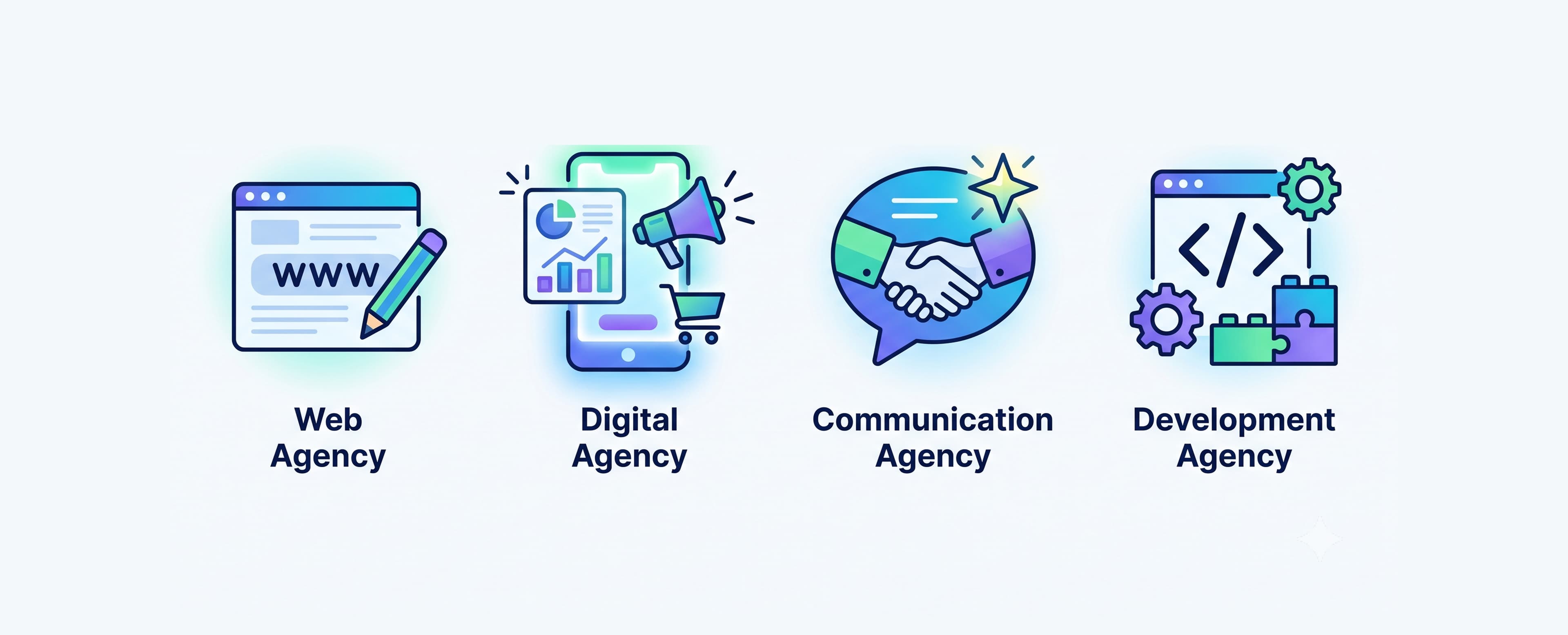
Launching a website, building an app, boosting your visibility, or reworking your brand image? Depending on what you actually need, you might turn to a web agency, a digital agency, a communication agency, or a development agency.
These terms get thrown around as if they're interchangeable, but they're not quite the same thing. Some agencies are built around visibility and communication; others handle the technical build of websites, apps, or business software. Knowing the difference helps you pick a partner that's genuinely suited to your project, your goals, and how your organization actually works.
The Differences, in a Nutshell
- A web agency mainly builds and improves websites, online stores, and their visibility on the web.
- A digital agency offers broader support that can span digital strategy, marketing, content, acquisition, design, and technology.
- A communication agency works primarily on brand image, messaging, and the materials used to reach an audience.
- A development agency handles the technical side of digital products — web apps, mobile apps, SaaS platforms, and business software.
That said, these lines aren't set in stone. A single agency can easily combine several of these skill sets. So look at what they actually do, what they've built, and how they work — not just what they call themselves.
What Is a Web Agency?
A web agency helps businesses build, redesign, and improve their online presence. Its work usually centers on websites and everything directly tied to making them run well.
That typically includes:
- building brochure-style websites;
- building e-commerce stores;
- redesigning existing sites;
- UX/UI design;
- integrating content management systems;
- optimizing performance and mobile display;
- ongoing technical maintenance;
- SEO and visibility tracking.
A web agency is a solid fit for businesses that want to showcase what they do, generate leads, sell online, or give an outdated site a fresh start.
That said, not every web agency has the same technical depth. Some lean mostly on CMS platforms and off-the-shelf solutions. Others have a real development team capable of building custom features or connecting your site to business tools.
What Is a Digital Agency?
A digital agency usually takes a wider view of things. It's not just thinking about your website — it's looking at your entire digital experience and strategy as a whole.
Its services can cover:
- digital strategy;
- building websites and platforms;
- content marketing;
- SEO and paid search;
- online advertising;
- social media;
- marketing automation;
- data analysis;
- optimizing customer journeys;
- designing digital products.
So the main difference between a web agency and a digital agency really comes down to scope. A web agency tends to focus on your online presence and getting it built. A digital agency connects strategy, acquisition, content, technology, and performance measurement into one bigger picture.
Still, "digital agency" remains a fairly loose label. Before signing on with one, ask exactly which parts of the work happen in-house and which get outsourced to partners.
What Is a Communication Agency?
A communication agency helps a company shape its image, positioning, and messaging. Its core job is making sure a brand communicates consistently with the different audiences it's talking to.
It commonly works on:
- brand strategy;
- visual identity and brand guidelines;
- advertising campaigns;
- writing messaging and content;
- print materials;
- press relations;
- events;
- internal communication;
- social media;
- photo and video production.
The difference between a digital agency and a communication agency mostly comes down to starting point. A communication agency starts from the brand and its message. A digital agency starts more from digital channels, user journeys, and measurable online goals.
Plenty of communication agencies now offer digital services too — they might build you a site or run online campaigns — but they don't always have a team built for developing complex applications.
What Is a Development Agency?
A web development agency is, above all, a technical partner. It builds digital solutions that need real architecture, code, databases, integrations, and ongoing maintenance.
It can build things like:
- custom web applications;
- iOS and Android mobile apps;
- SaaS platforms;
- client or employee portals;
- CRMs and management tools;
- marketplaces;
- dashboards;
- APIs and integrations between different software;
- business process automation;
- AI-powered solutions.
Unlike an agency built around communication, a development agency is mainly concerned with how the solution actually works: business logic, security, performance, data, scalability, and how it fits into your company's existing technical environment.
It's the right call whenever a project goes beyond simply presenting content and needs to handle users, payments, internal processes, data, or specific business rules.
Comparing the Different Types of Agencies
| Agency Type | Main Focus | Common Services | Best Suited For |
|---|---|---|---|
| Web agency | Building an effective online presence | Brochure sites, e-commerce, UX/UI, SEO, maintenance | Showcasing a business, generating leads, or selling online |
| Digital agency | Steering a broader digital strategy | Strategy, acquisition, content, data, customer journeys, technology | Coordinating several digital channels at once |
| Communication agency | Shaping a brand's image and messaging | Branding, campaigns, content, print, press, events | Building an identity, growing awareness, or unifying communication |
| Development agency | Building a custom technical solution | Applications, SaaS, business software, APIs, cloud, maintenance | Digitizing a process, launching a product, or building a complex platform |
Web Agency or Digital Agency: Which Should You Choose?
It really depends on how broad your need actually is.
A web agency can be plenty if your priority is building or redesigning an online presence with clearly defined goals. A digital agency makes more sense if your project touches several things at once: strategy, acquisition, content, customer experience, data analysis, and digital tools.
Ask yourself:
- Do you already have a clear strategy in place?
- Do you just need digital execution, or broader end-to-end support?
- Is driving traffic part of the project?
- Does the project call for custom-built features?
- Would you rather work with one point of contact across several disciplines?
Your answers will tell you whether you're really looking at a web production job, or a full digital transformation project.
Digital Agency or Communication Agency: What Actually Matters for Your Project?
Go with a communication agency when your priority is brand identity, positioning, messaging, or a campaign meant to run across multiple formats.
Lean toward a digital agency when the outcome you're after depends mainly on digital channels: online acquisition, conversion, automation, user journeys, or making sense of your data.
For a full rebrand paired with a new digital presence, you'll likely need both skill sets. A multidisciplinary agency can bring them together in-house, or coordinate the work with a specialized partner.
When Should You Choose a Web Development Agency?
A development agency becomes necessary once a project involves serious functional logic or specific technical constraints.
That's typically the case if you need to:
- connect several existing tools together;
- create user accounts and roles;
- automate internal operations;
- process or sync data;
- build a SaaS subscription product;
- integrate payments or third-party services;
- take over and rework an existing application;
- handle security, monitoring, and ongoing product evolution.
In that situation, dig into the team's actual technical experience, how they approach scoping, their ability to maintain the solution long-term, and the quality of comparable work they've delivered before.
Can One Agency Cover All of These Skill Sets?
Yes. Some agencies bring together strategy, UX/UI, development, content, acquisition, and maintenance under one roof, letting them support a project all the way from initial definition through launch and beyond.
That kind of setup has real advantages:
- fewer intermediaries to manage;
- smoother continuity between strategy, design, and development;
- clearer ownership of responsibilities;
- a more coherent vision for the product overall;
- simpler follow-up once things go live.
That said, a generalist agency is only worth it if its expertise in each discipline is real, not just claimed. Ask who will actually be doing the work, how the project will be run day to day, and what skills genuinely exist in-house.
MONARK IT takes exactly this approach, bringing together strategic scoping, UX/UI design, web development, mobile app development, SaaS, business solutions, automation, AI, and ongoing maintenance. Take a look at how our web agency in Marrakech supports clients end to end.
How Do You Actually Choose the Right Agency?
Don't pick an agency based on its label alone. Look instead at whether it can actually solve your problem.
Before committing, check:
- Do they understand your goal? The agency should be able to explain the outcome you're after, not just list deliverables.
- What skills do they actually have available? Design, development, acquisition, or communication, depending on what your project needs.
- Are their references genuinely relevant? Favor past work that's comparable in complexity to yours, not just work from the same industry.
- How do they actually work? Scoping, project stages, sign-offs, testing, and responsibilities should all be clearly defined upfront.
- What happens after launch? Make sure support, security, and future development are part of the plan.
- Is the budget transparent? Scope, assumptions, and any recurring costs should be spelled out clearly.
So the best agency isn't necessarily the one offering the longest list of services. It's the one whose skills genuinely match what you need — and one that can clearly explain how it plans to get you there.
FAQ
What's the difference between a web agency and a digital agency?
A web agency generally focuses on building, redesigning, and optimizing websites and online services. A digital agency tends to offer broader support that includes digital strategy, acquisition, content, data, customer experience, and technology.
What's the difference between a digital agency and a communication agency?
A digital agency works mainly on channels, user journeys, and digital performance. A communication agency focuses more on the brand, its messaging, and how that message gets distributed — whether through digital or traditional channels.
Can a communication agency build an app?
They can, if they have a development team in-house or work with a technical partner. For anything complex, it's worth checking exactly who will handle the architecture, the development, the testing, and the ongoing maintenance.
Which agency should you pick to build a SaaS product?
A SaaS project generally calls for a development agency or a digital agency with a genuine product and technical team behind it — one that can handle UX/UI, architecture, subscriptions, data, security, deployment, and future updates.
Do you need to work with multiple agencies?
Not necessarily. A multidisciplinary agency can cover several parts of a project on its own. For highly specialized needs, working with a few different partners can make sense — as long as their responsibilities and coordination are clearly defined from the start.
Wrapping Up
The real difference between a web agency, a digital agency, a communication agency, and a development agency comes down to what each one prioritizes: online presence, digital strategy, brand image, or technical execution.
Before choosing, get clear on the outcome you're after, the skills the project actually needs, and how much support you want along the way. From there, you can compare agencies based on their approach, their team, and their track record — not just what's on their business card.
Planning a website, an app, a SaaS platform, or a business solution? Tell MONARK IT about your project and get an initial take on the right scope and approach for what you're building.