An e-commerce platform has to support how your business actually operates, not just display a product catalog. Payments, inventory, shipping, promotions, customer service, accounting, and international sales can turn what looks like a simple project into something much bigger, fast.
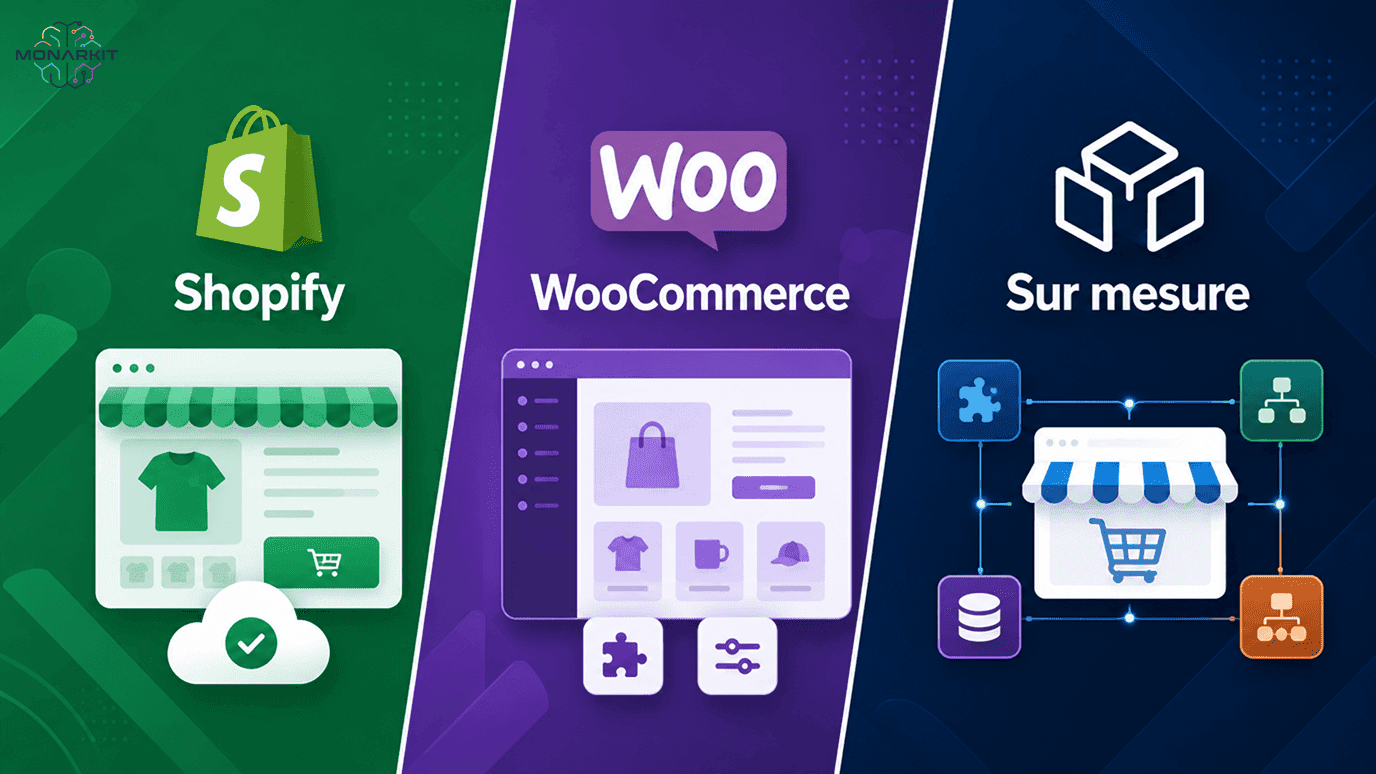
Shopify, WooCommerce, and a custom-built solution like Sylius are all solid options — they just fit different situations. The right choice starts with how your business actually operates, not with which platform sounds the most impressive.
Shopify: Less Technical Overhead to Get Started
Shopify gives you a hosted platform with admin tools, a catalog, order management, and a whole ecosystem of apps built around it. That's a great fit when a business wants to focus on its products, its marketing, and its day-to-day operations rather than managing infrastructure.
Shopify tends to make the most sense when you want to:
- test out a new market;
- launch a store built around fairly standard processes;
- get a manageable platform up and running quickly;
- keep technical responsibility off your own plate.
The limits start showing up once your business needs highly specific rules, a lot of integrations, or tight control over the underlying architecture. And subscription fees, app costs, and other platform charges all need to be factored into the real total cost, not just the sticker price.
WooCommerce: Pairing Content With Commerce
WooCommerce extends WordPress with e-commerce functionality. It can be a smart choice for a business where content and editorial SEO play a central role, or for a team that's already comfortable working in WordPress.
How flexible it actually is depends heavily on the theme, the plugins, and how well everything's been put together. Product count or visitor volume alone won't tell you much about how it'll perform — hosting, caching, database queries, plugins, images, and your actual business processes matter far more.
Maintenance needs to cover WordPress itself, WooCommerce, the theme, the plugins, backups, and testing after every update.
Custom-Built: Shaping the Platform Around Your Business
A custom solution starts to make sense once your platform needs to reflect rules that don't fit neatly into a standard product:
- B2B pricing that varies by client or contract;
- a marketplace with multiple sellers;
- a specific ordering or approval process;
- a complex product configurator;
- deep integrations with an ERP, PIM, CRM, or logistics system;
- particular requirements around international operations;
- e-commerce sitting at the very center of your broader information system.
Sylius, built on the Symfony ecosystem, is one solid option for building this kind of platform — though it's not the only architecture worth considering. What's right for you depends on your team's skills, the integrations involved, and your broader product strategy.
Decision Table
| Criterion | Shopify | WooCommerce | Custom-Built |
|---|---|---|---|
| Getting started | Fast for standard needs | Fast if your team already knows WordPress | Takes longer — real scoping and design involved |
| Hosting | Managed by the platform | Something you'll need to set up | Something you design and run yourself |
| Business customization | Bounded by the platform and its apps | Strong, through plugins and custom development | Very strong, scaled to your exact scope |
| Editorial content | Functional | A genuine strength of WordPress | Depends entirely on the CMS you choose |
| Complex integrations | Possible, with trade-offs worth evaluating first | Possible, but needs careful ongoing maintenance | Designed specifically around your information system |
| Recurring costs | Subscription, apps, and transaction fees depending on your plan | Hosting, licenses, maintenance | Hosting, maintenance, and ongoing development |
| Reversibility | Export and migration to plan for in advance | Data and code stay under your control, though licenses need checking | Needs to be arranged both contractually and technically |
Questions Worth Asking Before You Choose
- How are prices, promotions, and taxes actually calculated?
- Which payment methods are genuinely available in the markets you're targeting?
- How will inventory and shipping actually be managed?
- What data needs to flow to and from your ERP, CRM, or accounting system?
- Is this project B2C, B2B, a marketplace, or some hybrid of the three?
- Which languages, currencies, and legal entities are you planning to support?
- Who's going to run the store day to day, and who'll maintain it?
- What's the plan if you ever need to move off this platform?
A Simple Recommendation — Though Not an Automatic One
- Shopify if your processes are fairly standard and you want to keep technical overhead low.
- WooCommerce if content, WordPress, and plugin-driven flexibility fit how your team already works.
- Custom-built if your business rules and integrations are a genuine competitive edge that the platform needs to reflect, not work around.
Starting on a standard platform can be a perfectly smart move, as long as you plan ahead for data, integrations, and a potential future migration. On the flip side, custom development isn't justified by growth ambitions alone — it needs to be answering real, specific complexity, not just future-proofing for its own sake.
Learn more about our approach to building e-commerce sites, and check out our Next.js vs. WordPress comparison to dig deeper into architecture decisions.