Chances are you've run into this debate in the middle of a project kickoff meeting. Someone on the technical team says "so, are we going with REST or GraphQL?", everyone nods knowingly, and you're left wondering what that actually means for your project.
Here's the good news: this isn't some mystical decision reserved for developers. It's an architecture choice with a very real impact on your budget, your timeline, and the experience your users end up having. And once you strip away the jargon, it's actually pretty easy to follow. We'll walk you through it in plain terms — and help you figure out what makes sense for your own project, whether you're scoping a new app build or rethinking the backend of something you already have.
Why This Choice Deserves Your Attention, Even If You're Not a Developer
It's tempting to leave this kind of decision entirely to "the tech people." But the choice between REST and GraphQL touches some very concrete business questions: how quickly your team can ship a new feature, how much you'll pay in hosting over time, whether your app feels snappy or a bit sluggish to your users, and how easily it can grow when you add a mobile version or a new internal dashboard down the line.
We've seen too many projects hit a wall six months after launch, forced into a costly rebuild because the original architecture just couldn't keep up. So this topic is worth ten minutes of your attention now, rather than weeks of rework later.
REST: The Tried-and-True Classic
REST has been around for a long time, and for good reason: it's simple. The basic idea is to organize your data around "resources" — a user, a product, an order — each with its own address. To interact with them, you use a handful of straightforward actions: fetch a piece of data, create one, update it, or delete it.
What makes REST appealing is exactly that simplicity. Any developer, even a junior one, can grasp the logic within minutes. Documentation and tooling are everywhere, which makes hiring and onboarding a lot easier. And since it's such a long-standing standard, browsers and servers already know how to cache these exchanges efficiently. For a dynamic marketing site, an admin dashboard, or an app with fairly predictable data needs, REST does the job well.
Where it starts to show its limits is when each screen in your app needs several round trips to the server, and some of those round trips bring back more data than you actually need. On a mobile connection that isn't great, that extra weight can be felt.
GraphQL: When Flexibility Becomes an Advantage
GraphQL was born at Facebook, where it was used internally before being released as open source in 2015. Its whole purpose was to solve exactly the problem above. Instead of firing off multiple requests, it lets your app ask for precisely what it needs — in a single round trip, nothing more, nothing less.
In practice, that means less unnecessary data moving back and forth, so your app feels faster, especially on mobile. It also gives your front-end team more independence, since they no longer have to wait for the backend to build a custom endpoint every time a screen's data needs change. And if your product lives across multiple platforms — a website, a mobile app, an internal tool — a single GraphQL API can feed all three, with each one pulling only what it actually needs.
The trade-off is that GraphQL asks a bit more of your team. Caching takes more thought to set up properly, and you need real discipline to keep certain queries from becoming too heavy for the server to handle.
A Concrete Example to Picture the Difference
Nothing beats a real-world scenario to see why this choice actually matters. Imagine you're building an e-commerce app, and the home screen needs to show a list of products, the category name for each one, and their current stock level.
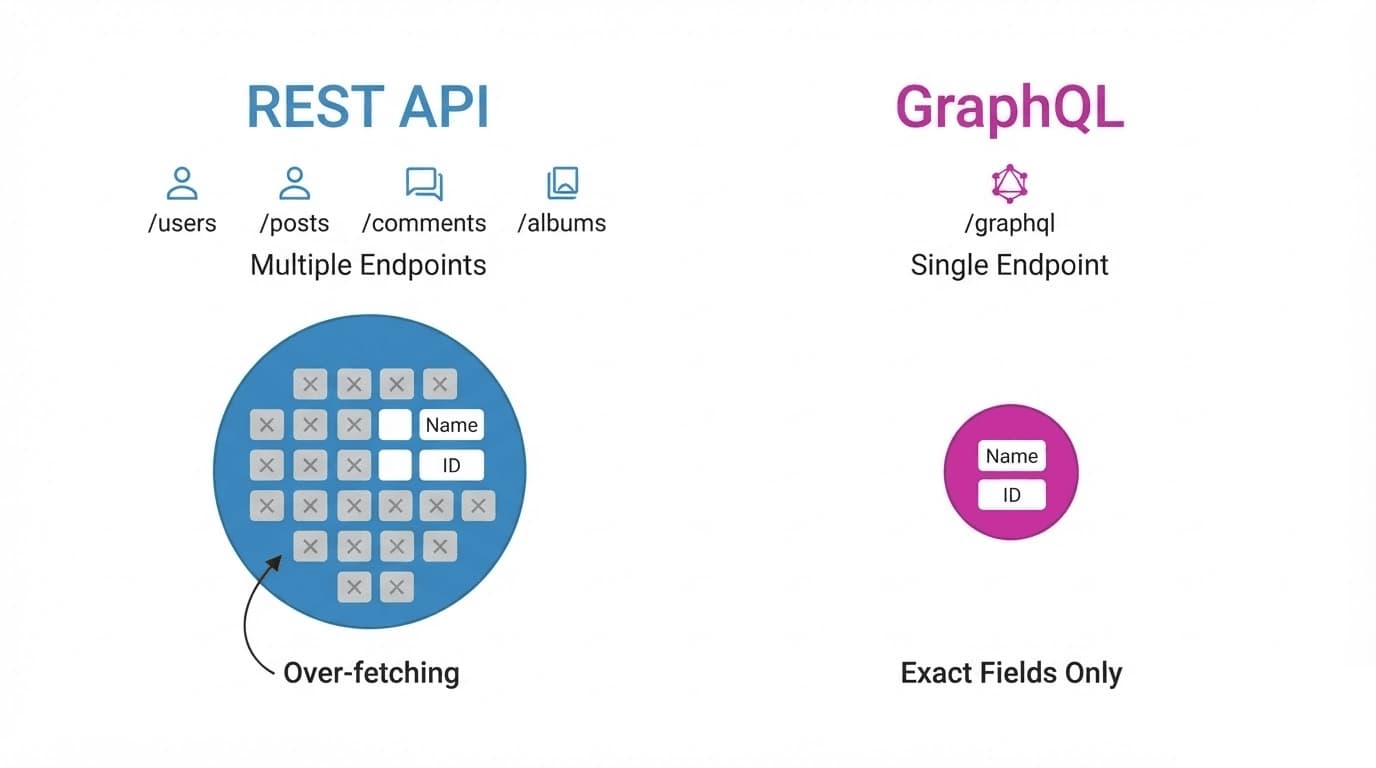
With a classic REST API, your front-end would typically need to chain several calls: one to fetch the list of products, another to get the category for each product, and yet another to check stock levels. This has a name in technical circles — it's called "under-fetching," when a single request never quite gets you everything a screen needs to display. And the flip side happens too: those same calls often come back with information your app doesn't even need at that moment — the well-known "over-fetching" problem, which adds unnecessary weight to every exchange.
With GraphQL, that same screen could pull all three pieces of information — products, category, stock — in a single request, no more and no less. The client describes exactly what it needs, and the server responds precisely to that, without any detours. This is exactly why GraphQL is often seen as more efficient for data-rich interfaces, where each screen combines several related types of information.
This isn't just a theoretical nicety. On an app with a lot of screens like this, the difference in the number of requests and the volume of data exchanged can genuinely be felt in how fast the app loads for your users, especially on mobile.
So, How Do You Decide for Your Project?
Here are the questions we always ask before recommending an architecture to a client, whether that's an internal team or through our digital development agency:
Does your app live across several interfaces (web, mobile, internal tool) that consume the same data in different ways? GraphQL clearly has the edge here. Is your project fairly simple, with standard data flows, like a typical online store or an admin panel? REST is usually the more cost-effective choice, by a good margin. Is your team already comfortable with one technology over the other? Never underestimate how much time a learning curve can cost you. Is mobile performance critical for your users? GraphQL noticeably cuts down the amount of data exchanged. And if you're racing to ship an MVP, REST is generally quicker to get up and running.
There's no one-size-fits-all answer, and it's actually pretty common to see both approaches living side by side in the same project: REST for the simple stuff, a GraphQL layer for the more complex screens. That's exactly the kind of assessment we make during a technical audit, before a single line of code gets written.
Don't Let This Technical Choice Hold Back Your Launch
Choosing between REST and GraphQL isn't just a matter of developer preference. It's a decision that needs to match your business goals, your budget, and the direction you want your product to grow in. Getting it wrong gets expensive down the road; getting it right from the start can save you months.
At Monark IT, we help Moroccan and European businesses make this kind of call — and put it into practice — whether that's a custom web application, a mobile app, or a more complex e-commerce project.
Still on the fence between REST and GraphQL for your project? Get in touch with our team for a free technical conversation: we'll take a close look at what you need and recommend the architecture that actually fits, no jargon attached.
FAQ: REST API vs GraphQL
Can you migrate from REST to GraphQL without rebuilding everything?
Yes, and it's actually a common approach. You add a GraphQL layer on top of your existing REST API, which allows for a smooth transition without rewriting the entire backend at once.
Is GraphQL always faster than REST?
Not necessarily on the server side, but often yes from the user's perspective, since fewer requests and less unnecessary data are exchanged.
Is REST outdated?
Not at all. It's still a great fit for plenty of projects, particularly simple applications or sites that don't need a lot of flexibility around their data.