Artificial intelligence is gradually transforming how businesses in Morocco operate. From task automation and AI assistants to document analysis and business software integration, its applications extend far beyond everyday uses of ChatGPT.
However, adopting AI is not simply about installing another tool. It requires understanding existing processes, identifying opportunities, and building solutions that address real business needs.
Working with an AI agency in Morocco can help businesses structure this journey, from the initial assessment to deployment.
But how do you choose the right partner and avoid investing in technology that delivers little practical value?
Why Intelligent Automation Is Becoming a Business Performance Driver
In many organizations, employees spend considerable time on repetitive operations: processing emails, entering data, qualifying leads, preparing documents, and generating reports.
These activities are necessary, but they can slow down higher-value work.
Intelligent automation simplifies selected processes by combining business rules, existing software, and artificial intelligence models.
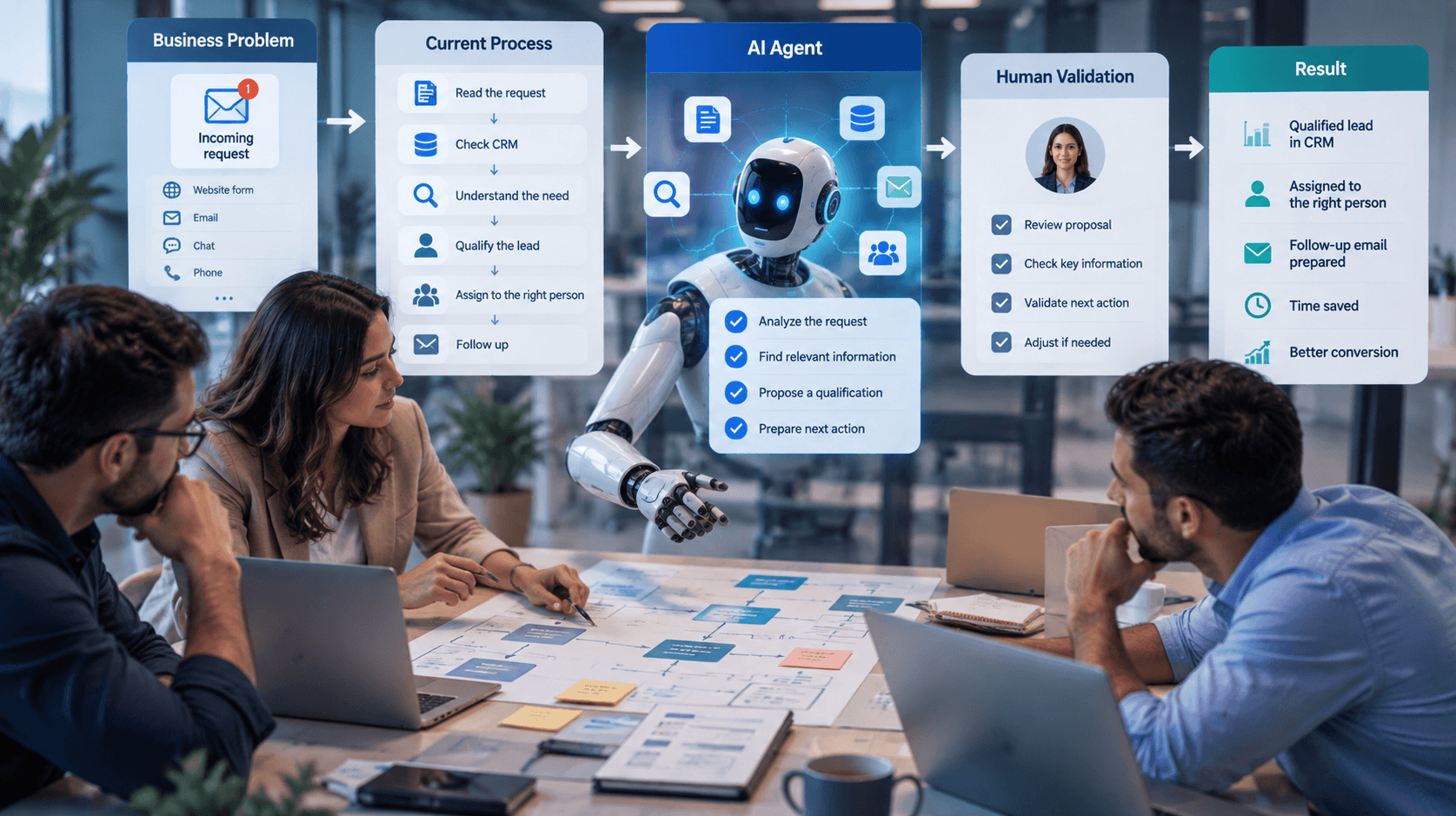
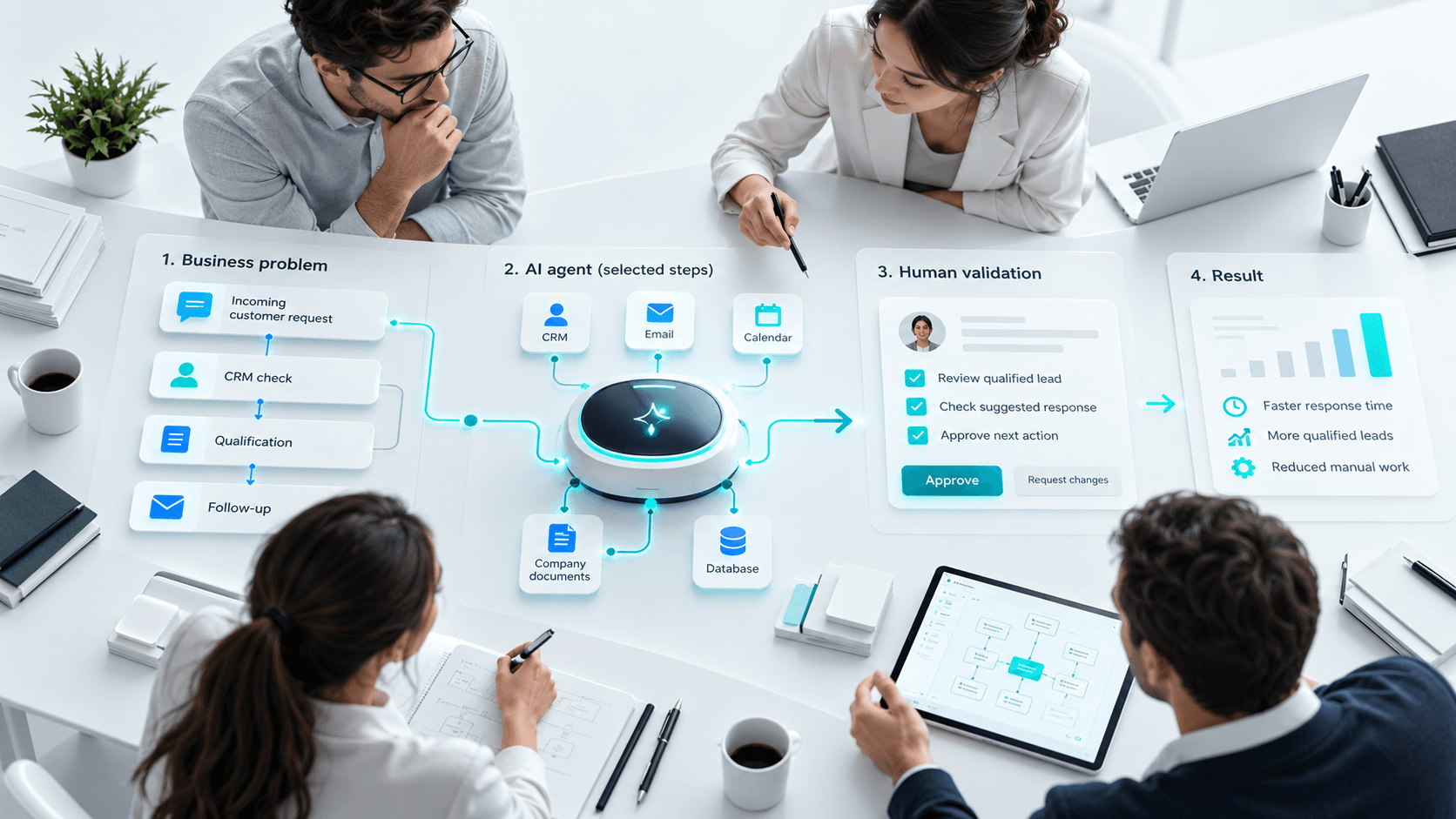
For example, a system can analyze an incoming sales inquiry, identify missing information, and prepare a response for human approval.
The objective is not to automate everything, but to reduce unnecessary manual work while improving processing speed and quality.
Beyond Chatbots: The Real Role of an AI Agency
An artificial intelligence agency helps businesses identify, design, and implement solutions tailored to their operations.
Its role goes well beyond developing chatbots.
An agency may build:
- AI agents that use connected tools and perform authorized actions.
- Intelligent workflows that automate administrative and commercial processes.
- RAG-powered knowledge assistants that retrieve information from internal documents.
- LLM-powered applications that enhance existing business software.
- CRM and ERP integrations that improve information flow across systems.
The agency's main responsibility is to determine which approach best addresses the problem.
Sometimes, traditional automation is more appropriate than a complex AI agent.
To explore these solutions, visit MONARK IT's AI development and integration services.
SMEs, Startups, and Enterprises: Who Can Benefit from AI?
Contrary to popular belief, artificial intelligence is not reserved for large organizations with substantial budgets.
AI adoption depends primarily on operational needs, business volume, and data availability.
SMEs: Simplifying Everyday Operations
Small and medium-sized enterprises can automate sales follow-ups, improve customer request handling, and streamline document management.
The priority is achieving measurable improvements without introducing unnecessarily complicated tools.
Startups: Enhancing Digital Products
Startups can integrate intelligent features directly into their applications, including semantic search, personalized recommendations, and specialized assistants.
Established Businesses: Connecting Existing Systems
Organizations using CRM platforms, ERP solutions, or multiple business applications can develop AI agents that access and process authorized information.
Ultimately, the value of an AI project depends more on the business problem than on company size.
From Initial Assessment to Production: The Stages of a Successful AI Project
Effective AI implementation requires a structured, progressive approach.
1. Identify a Specific Business Problem
The first step is to understand current operations: which tasks consume time, what data is available, and what outcomes are expected?
A specific objective, such as accelerating lead qualification, is more useful than a general ambition to transform the company through AI.
2. Validate Feasibility with a Prototype
A proof of concept (PoC) allows the proposed solution to be tested within a limited scope.
It helps evaluate model capabilities, data quality, and integration constraints.
3. Integrate and Secure the Solution
Once feasibility is confirmed, the agency connects AI to existing applications, configures permissions, and prepares deployment.
The project must also account for errors, monitoring, and necessary human intervention.
4. Measure Results and Improve Continuously
After deployment, the solution should be evaluated using practical indicators: processing time, output quality, operating costs, and user adoption.
To prepare for this process, read our guide on how to define your first AI agent use case.
Essential Criteria for Choosing a Reliable AI Partner in Morocco
Choosing an AI agency should involve more than comparing demonstrations or technology lists.
Several criteria help evaluate potential providers:
| Criterion | Key Question |
|---|---|
| Technical expertise | Does the agency understand APIs, LLMs, and software architecture? |
| Business understanding | Does it analyze your workflows before recommending a solution? |
| Track record | Can it demonstrate completed projects and practical experience? |
| Security | How does it protect data and manage access permissions? |
| Transparency | Are costs, timelines, and limitations clearly explained? |
| Ongoing support | Does it provide maintenance after deployment? |
Particular attention should be paid to integration with existing software.
An AI agent may perform well in a demonstration but become difficult to operate if it cannot communicate reliably with the company's information systems.
Choose a partner that combines AI expertise, software engineering, and an understanding of real business operations.
What Investment Should You Expect for an AI Project?
The budget depends on functional complexity, available data, connected applications, and security requirements.
It is important to distinguish initial development costs from ongoing expenses such as LLM API usage, hosting, maintenance, and monitoring.
Return on investment is measured by comparing the benefits achieved with the costs incurred.
For example, reducing processing time by three minutes across 2,000 requests represents a theoretical saving of 100 working hours per month.
Those savings must then be validated under real operating conditions.
A profitable AI project is not necessarily the cheapest option. It is one where the operational benefits sustainably justify the investment.
Common Mistakes That Can Undermine an AI Automation Project
Several mistakes frequently occur during AI implementation projects:
- Choosing technology before defining the business problem: selecting an AI model or platform without clearly identifying the operational challenge it should solve.
- Trying to automate too many processes at once: expanding the project scope too quickly, increasing complexity and delaying deployment.
- Working with incomplete or unreliable data: using information that is insufficient or poorly structured, which can reduce the quality of AI-generated results.
- Overlooking access controls and security: allowing AI agents to access systems or perform actions without clearly defined permissions and safeguards.
- Failing to establish performance indicators: making it difficult to evaluate actual improvements, operating costs, and return on investment.
- Underestimating employee adoption: delivering a technically functional solution that teams rarely use in their daily workflows.
To avoid these mistakes, start with a clearly defined use case, test it using representative data, and gradually expand the automation's scope as its reliability is validated.
AI Agents and Human Oversight: Balancing Autonomy and Control
An AI agent can retrieve information, prepare documents, or trigger certain actions.
However, not every decision should be automated.
Financial changes, sensitive communications, and decisions affecting employees may require human approval.
It is therefore essential to define authorized actions, access rights, and control mechanisms.
Autonomy should increase progressively as the system's reliability is evaluated.
To explore this topic further, read our guide on supervising AI agents in business without losing control.
MONARK IT: An AI Development and Integration Agency in Morocco
Based in Marrakech, Morocco, with a presence in Qatar, MONARK IT combines custom software development, artificial intelligence, and business application integration to help companies turn AI opportunities into practical solutions.
Our approach focuses on real business challenges rather than technology alone. We help organizations identify relevant use cases, integrate intelligent capabilities into existing systems, and deploy solutions adapted to their operational requirements.
Our expertise includes:
- Custom AI agents: developing agents that retrieve information, interact with business tools, and execute authorized tasks.
- Business process automation: simplifying repetitive workflows, including lead qualification, document processing, and administrative operations.
- AI-powered applications: integrating large language models (LLMs), intelligent assistants, and RAG-based knowledge retrieval into custom software.
- CRM and ERP integration: connecting AI solutions to existing platforms, including Zoho CRM and other business applications, through APIs and automation workflows.
- AI deployment and monitoring: supporting implementation, access controls, human oversight, and continuous performance evaluation.
By combining AI engineering with software development expertise, MONARK IT helps businesses move beyond isolated prototypes toward solutions that fit their existing operations.
Explore our AI agency and artificial intelligence integration services in Morocco to discover our capabilities, technical approach, and selected projects.
FAQ: Choosing an AI Agency in Morocco
Why should a business work with an AI agency in Morocco?
An AI agency helps businesses identify relevant use cases, develop intelligent solutions, and integrate them with existing software. It provides the technical expertise and implementation methodology needed to turn business requirements into operational systems.
How much does an AI project cost in Morocco?
The budget depends on project complexity, data availability, required integrations, and security requirements. Businesses should also account for ongoing expenses, including hosting, AI model usage, maintenance, and monitoring.
Can an SME adopt AI without an internal technical team?
Yes. An SME can outsource AI development and integration to a specialized agency. However, it should appoint a business representative to define requirements, validate results, and support employee adoption.
What is the difference between a chatbot and an AI agent?
A chatbot primarily responds to user questions. An AI agent can also use tools, retrieve information, and perform authorized actions. Its level of autonomy depends on the permissions, business rules, and safeguards established by the organization.
Can AI be integrated with an existing CRM or ERP?
Yes, provided the software offers suitable features and APIs. AI can support lead qualification, information retrieval, and the preparation of data updates without necessarily replacing the existing CRM or ERP.
How long does it take to develop an AI solution?
The timeline depends on functional scope, data quality, and the number of systems involved. A limited prototype can be developed faster than a production-ready solution requiring extensive integrations, security controls, and testing.
How can businesses protect sensitive data when implementing AI?
Data protection requires appropriate architecture, restricted access permissions, encryption where necessary, and careful assessment of technology providers. Private hosting or locally deployed models may also be considered depending on project requirements.
How do you measure the return on investment of an AI agent?
Compare performance before and after deployment, including processing time, task volume, error rates, service quality, and operating costs. ROI should be calculated using actual business data over a defined period.
Conclusion: Turning an AI Idea into a Practical First Project
The success of an artificial intelligence project does not depend on how many tools are deployed, but on its ability to solve a specific business problem.
Before investing, identify a repetitive task, assess the available data, and define the expected outcomes. A focused, measurable first project allows you to validate the approach before expanding it to other business operations.
The right question is not "How can we integrate AI everywhere?" but "Where can AI create the most value today?"
Have a process in mind? Talk to our team to assess its feasibility and identify the next steps.