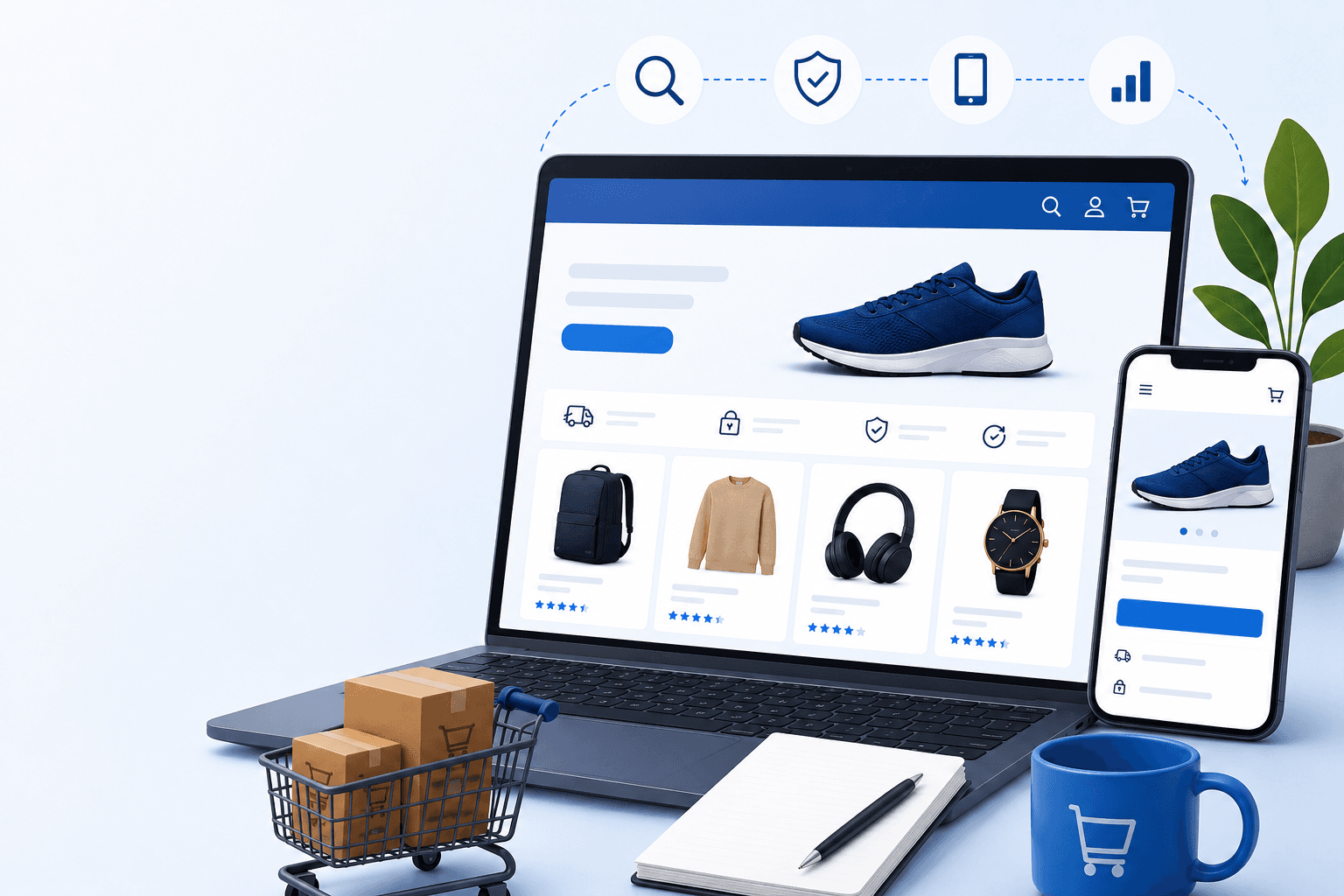
Building an online store is now within reach of many businesses. However, putting a product catalogue online is not enough to generate sales. Many e-commerce websites struggle to convert visitors, not because their products are poor, but because the experience they offer fails to meet users' expectations.
A high-performing e-commerce website must be fast, easy to use, and designed to guide visitors all the way through checkout. Every detail, from the navigation menu to payment, has a direct impact on the conversion rate.
In this guide, discover the essential steps for creating a high-performing online store, the features to prioritise, and the best practices that can turn your website into a genuine growth engine.
Why Is Careful Planning Essential Before Building an E-commerce Website?
Before choosing a platform or working on the design, it is important to define the foundations of your project. This planning will help you avoid unsuitable technical choices and build a store that can grow with your business.
Start by identifying your objectives. Do you want to sell a few dozen products or manage a much larger catalogue? Are your customers consumers, businesses, or both? Your answers will determine which features need to be developed.
Thorough preparation also makes future changes easier, such as adding new payment methods, integrating a CRM, or expanding into new markets.
Which Features Are Essential for a High-Performing E-commerce Website?
An online store should make the buying journey as simple as possible. Visitors must be able to find the product they want quickly and complete their order without difficulty.
The following features are now essential:
- simple, intuitive navigation;
- a powerful search engine;
- well-organised categories;
- detailed product pages;
- a clear shopping cart;
- several secure payment methods;
- a customer account area;
- order tracking.
Every feature should address a genuine need. Adding unnecessary options can make the user experience more complicated instead of improving it.
How Do You Create Product Pages That Encourage Purchases?
The product page is often the final point of contact before a purchase decision. It must answer the visitor's main questions and inspire confidence.
Use high-quality photographs, a clear description, essential specifications, and precise information about availability and delivery times. Where possible, add customer reviews or frequently asked questions to reassure potential buyers.
A complete product page not only improves conversion rates but also contributes to your store's search engine optimisation.
How Can You Deliver an Excellent User Experience?
Visitors should never have to stop and think about how to use your website. Smooth navigation, fast pages, and a clear interface make the journey more enjoyable and increase the likelihood of conversion.
Loading speed is also a key part of the user experience. A slow store can discourage buyers before they even view your products. Optimising images, limiting unnecessary scripts, and choosing reliable hosting are simple but effective measures.
Your website must also work perfectly on smartphones. A significant share of online purchases is now made on mobile devices, making a responsive interface essential.
Why Is Trust So Important for an Online Store?
When visitors discover your store for the first time, they do not yet know your business. Before purchasing, they naturally look for signs that reassure them.
Clearly display your contact details, delivery terms, returns policy, and accepted payment methods. Customer reviews and security certifications also strengthen your website's credibility.
Trust begins to form within the first few seconds of a visit and directly influences the purchasing decision.
How Can SEO Improve the Visibility of Your E-commerce Website?
Even the best online store cannot generate sales if it remains invisible in search engines. Search engine optimisation attracts qualified visitors who are already looking for the products or services you offer.
Every page on your website deserves careful attention. Product pages should contain original descriptions, optimised titles, and properly labelled images. Category pages should address users' search intent.
To strengthen your visibility, publish useful blog content regularly. Practical guides, comparisons, and usage tips can answer potential customers' questions while improving your rankings on Google.
Which Mistakes Should You Avoid When Building an Online Store?
Some mistakes can limit a website's performance from the moment it launches. Avoiding them from the outset saves time and quickly improves the experience offered to users.
The most common mistakes include:
- prioritising visual design over usability;
- neglecting the mobile version;
- publishing incomplete product pages;
- adding too many steps before payment;
- overlooking search engine optimisation;
- failing to analyse performance after launch.
A high-performing store is always evolving. Analysing visitor behaviour helps identify points of friction and supports continuous improvement.
How Do You Measure the Performance of Your E-commerce Website?
An online store should not be considered complete once it goes live. In fact, that is when the real optimisation work begins.
To determine whether your website is meeting its objectives, you need to monitor several performance indicators regularly. These metrics reveal both the strengths of your store and the areas that require adjustment.
The main indicators to track are:
- conversion rate;
- average order value;
- cart abandonment rate;
- number of visitors;
- traffic sources;
- revenue generated;
- customer retention rate.
These data points help you make decisions based on evidence rather than assumptions.
Why Should You Continuously Optimise Your Online Store?
Consumer behaviour is constantly changing, as are e-commerce technologies and trends. A store that performs well today must continue adapting to remain competitive tomorrow.
Analysing user journeys, testing new features, and improving page speed are all actions that can gradually increase performance.
The goal is not to change everything repeatedly, but to improve your website continuously using customer feedback and collected data.
Key Steps for Building a High-Performing E-commerce Website
Before launching your online store, make sure the main elements required for success are in place.
- ✅ Clearly define your commercial objectives.
- ✅ Identify your target audience and its needs.
- ✅ Choose a technical solution suited to your project.
- ✅ Design simple, intuitive navigation.
- ✅ Create complete and appealing product pages.
- ✅ Secure payments and reassure visitors.
- ✅ Optimise your website for mobile devices.
- ✅ Address SEO from the design stage.
- ✅ Measure your store's performance regularly.
- ✅ Evolve your platform according to customer needs.
This checklist provides a strong foundation for building a sustainable and scalable e-commerce project.
FAQ – Building a High-Performing E-commerce Website
How Much Does It Cost to Build an E-commerce Website?
The cost mainly depends on the complexity of the project, the number of required features, and the desired level of customisation. A standard online store does not require the same investment as a fully bespoke e-commerce platform.
How Long Does It Take to Build an Online Store?
The timeline varies according to the company's needs. A simple project can be completed in a few weeks, while a website with specific features or ERP and CRM integrations will generally require several months of development.
Can You Build an E-commerce Website Without Technical Knowledge?
Yes. Some solutions let you create a store quickly using ready-made templates. However, when a project requires specific features or significant scalability, working with a specialist agency is often the better option.
What Is the Best CMS for Building an Online Store?
There is no single answer. The right choice depends on your catalogue, budget, objectives, and planned developments. WooCommerce, Shopify, PrestaShop, and bespoke development each address different needs.
How Can You Attract Visitors to an Online Store?
An e-commerce website's visibility generally relies on several complementary channels: search engine optimisation, online advertising, social media, email marketing, and a blog-based content strategy.
The more diversified your acquisition strategy is, the better your chances of attracting qualified traffic.
How Do You Know Whether Your E-commerce Website Is Performing Well?
Website performance cannot be measured by visitor numbers alone. You should also analyse conversion rate, average order value, cart abandonment rate, time spent on the website, and customer retention.
These indicators help assess your store's effectiveness and identify opportunities for improvement.
What Comes Next: Turning Your Store into a Genuine Sales Channel
Building a high-performing e-commerce website is an essential step, but the success of a project does not depend on design alone. Once your store is online, you need to attract visitors, increase visibility, and convert that traffic into sales.
Search engine optimisation, social media, advertising campaigns, and email marketing are all channels that can help grow your business and build customer loyalty.
But how can you sell products online without owning a physical store? Find out in our next guide: How to Sell Products Online Without a Physical Store: A Guide to Starting Your E-commerce Business.