Building an online store is a big step, but it's not what actually determines whether an e-commerce project succeeds. Before you even start picking a platform or uploading products, there's a more fundamental question to answer: who are you actually trying to sell to?
Some businesses sell straight to consumers. Others work exclusively with other companies. And some simply connect buyers and sellers without selling anything themselves. Each of these e-commerce models comes with its own rules, its own logic, and its own technical requirements.
In this article, we'll walk through the main e-commerce models, how they differ, what each one offers, and the questions worth asking to figure out which one genuinely fits your business.
Why Does Choosing the Right E-commerce Model Actually Matter?
A lot of entrepreneurs assume an e-commerce site works pretty much the same way no matter who's buying. In reality, a site built for individual shoppers doesn't solve the same problems as a platform built exclusively for businesses.
The model you choose shapes nearly every part of the project: the user experience, the features you'll need, how payments work, how orders get managed, and even your marketing strategy.
Taking the time to define your model upfront saves you from expensive rework later, and sets you up with a store that can actually grow alongside your business.
What Are the Different E-commerce Models?
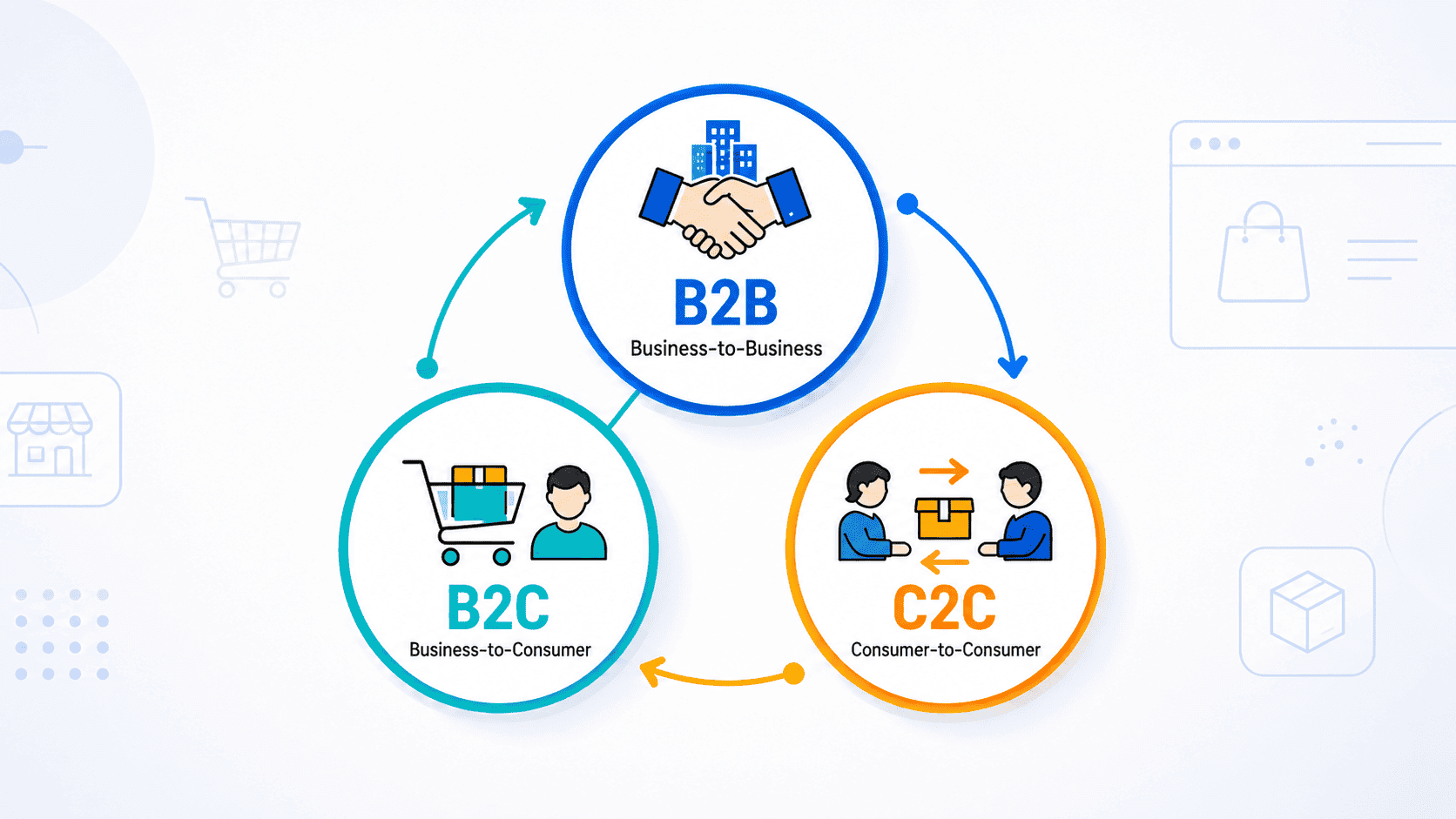
E-commerce generally breaks down into three main models: B2B, B2C, and C2C. Each one follows a different commercial logic.
Understanding how each one actually works makes it a lot easier to figure out which one fits your goals.
What Is the B2B (Business to Business) Model?
The B2B model means selling products or services from one business to another.
Unlike selling to the general public, B2B purchases tend to be bigger, often involve several decision-makers, and can take longer to get approved. Orders are often recurring, pricing is frequently customized, and the buying cycle tends to stretch out.
Think of an industrial company supplying spare parts to manufacturers, or a wholesaler selling its catalog to distributors — both are textbook B2B setups.
A B2B store typically needs specific features like:
- professional client accounts;
- customized catalogs;
- negotiated pricing;
- quote requests;
- bulk ordering.
When Does a B2B Model Make Sense?
The B2B model fits particularly well for businesses selling to other professionals.
It tends to suit industries like:
- manufacturing and industry;
- professional equipment;
- office supplies;
- SaaS software;
- B2B services.
In this world, the goal isn't just closing a sale quickly — it's building a business relationship that lasts.
What Is the B2C (Business to Consumer) Model?
B2C is the model most people are already familiar with. It means selling products or services directly to individual consumers.
It's how the vast majority of online stores operate: fashion, cosmetics, electronics, food, home decor, sporting goods — the list goes on.
In this model, the buying journey needs to be simple, fast, and reassuring. Most visitors make up their minds within minutes, not days.
That's why a B2C store puts the focus on:
- smooth, intuitive navigation;
- detailed product pages;
- customer reviews;
- promotions;
- fast, frictionless checkout.
Why Is B2C the Most Widely Used Model?
The rise of digital tools and online shopping habits has pushed B2C well ahead of the other models in sheer popularity.
Today's consumers want simple ways to buy whatever they need, whenever they need it, from their laptop or their phone.
For businesses, that's a real opportunity — more visibility, a bigger market, and the ability to sell without depending entirely on a physical storefront.
That said, it also means facing serious competition. Standing out requires a genuinely good user experience and a real acquisition strategy — not just a nice-looking site.
What Is the C2C (Consumer to Consumer) Model?
The C2C model runs on exchanges between individuals.
Here, the platform itself doesn't sell anything directly — it simply connects sellers and buyers.
Marketplaces built around secondhand goods, or classified-ad platforms, are the classic examples of this model in action.
The platform's job mostly comes down to:
- making exchanges easy;
- keeping transactions secure;
- offering solid search tools;
- building trust between users who don't know each other.
A C2C platform's success depends far more on the strength of its community than on any product catalog.
What Are the Advantages and Limits of the C2C Model?
The biggest advantage of C2C is how quickly you can build a wide-ranging offering without ever having to manage inventory yourself.
On the flip side, this model demands real attention to content moderation, payment security, and the overall quality of interactions between users.
Building a marketplace that actually works well is usually a more complex development effort than a standard e-commerce store.
How Do B2B, B2C, and C2C Actually Differ?
All three models revolve around selling online, but their goals and mechanics couldn't be more different. Picking the right one directly shapes how your store gets built, which features you need, and what commercial strategy makes sense.
| Criterion | B2B | B2C | C2C |
|---|---|---|---|
| Customers | Businesses | Individuals | Individuals |
| What's being sold | Professional products or services | Consumer products | Peer-to-peer exchanges |
| Buying decision | Slower | Fast | Varies |
| Average order value | Generally high | Moderate | Low to moderate |
| Key features | Quotes, custom pricing, business accounts | Fast checkout, promotions, reviews | User management, listings, messaging |
| Main goal | Building a lasting business relationship | Driving quick sales | Connecting buyers and sellers |
This table makes one thing clear: there's no universal model. Every business needs to build its project around its own market and its own goals.
How Do You Choose the E-commerce Model That Fits Your Business?
The right model comes down to your business and who you're actually selling to. Before building an e-commerce site, it's worth answering a few simple questions:
- Who do you actually want to sell to?
- Are your customers individuals, businesses, or both?
- Is pricing the same for every customer, or does it vary?
- Are your sales one-off, or mostly recurring?
- Do you need a marketplace, or a more traditional store?
Your answers will help you pin down which features you genuinely need — and steer you away from building a site that doesn't actually fit.
Selling to Individual Consumers?
If your goal is selling clothing, accessories, food, or any other product aimed at the general public, B2C is almost certainly the model you want.
Here, visitors are looking for smooth navigation, complete product pages, and fast checkout. User experience becomes a genuine conversion lever, not just a nice-to-have.
Working Mainly With Other Businesses?
If your customers are distributors, resellers, or other companies, B2B is going to serve you better.
A B2B store lets you manage specific catalogs, custom pricing terms, quotes, and bulk orders — and it tends to integrate more easily with an ERP or CRM system too.
Building a Collaborative Platform?
If your project is about letting users sell directly to each other, you're looking at a C2C model.
In that case, your priority won't be managing a product catalog — it'll be building a platform that's reliable, secure, and able to handle a large number of users at once.
How Does the E-commerce Model Shape Your Store's Design?
Quite a bit, actually. Two e-commerce sites can look nearly identical on the surface while serving completely different needs underneath.
A B2C store will prioritize a frictionless buying experience, while a B2B platform will need more advanced features built specifically around what professional buyers expect.
The model you choose shapes:
- your site's overall architecture;
- how customer accounts are managed;
- the checkout flow;
- available payment methods;
- inventory management;
- integrations with other business tools.
Nailing these requirements down early makes it much easier to build a platform that can scale — and that won't become a headache to maintain later.
What Mistakes Should You Avoid When Choosing Your E-commerce Model?
A handful of mistakes come up again and again when businesses launch a digital project.
Trying to Copy a Competitor
What works for another business won't necessarily work for your market. Your site needs to be built around your own goals, not someone else's playbook.
Focusing Only on Design
How a store looks matters, but it's never the whole story. Features, performance, and the overall user experience matter just as much — arguably more.
Ignoring How the Project Will Need to Grow
Every business changes over time. Your platform needs to be able to grow with you, without forcing a complete rebuild a few months down the line.
Choosing a Solution Based on Price Alone
The upfront cost shouldn't be your only deciding factor. A solution that doesn't actually fit your needs can end up costing you far more later — in maintenance, in rework, or in lost productivity.
Why Get Expert Support for an E-commerce Project That Actually Performs?
The e-commerce model you choose shapes every stage of the project, from initial design all the way through development.
Working with the right team helps you pin down what your business genuinely needs, prioritize the features that actually matter, and choose technology that fits — instead of guessing.
At Monark IT, we help businesses build custom e-commerce platforms designed to grow alongside their operations and their goals.
So, What's the Next Step for Your E-commerce Project?
Choosing between B2B, B2C, and C2C isn't just about identifying your type of customer. That choice ripples out into your store's features, your commercial strategy, and the overall experience you'll offer your customers.
Taking the time to really understand your market and your goals lays the groundwork for an e-commerce project that's solid, scalable, and genuinely built around your business. Once your model is locked in, it's time to move on to actually designing your store.
But how do you actually build a high-performing e-commerce site — one that delivers a great user experience and turns visitors into paying customers? That's exactly what we'll cover in our next guide: Building a High-Performing E-commerce Site: The Key Steps to Designing a Store That Converts.